Gallbladder Stones (Pitt ki Pathri) – Complete Guide
Gallbladder stones, known in Punjabi and Hindi as Pitt ki Pathri, are hard, pebble-like deposits that form inside the gallbladder — the small pouch that stores digestive bile beneath your liver. Gallstones are one of the most common digestive conditions in Punjab and across India, affecting approximately 1 in 10 adults.
Gallstones form when the chemical composition of bile becomes imbalanced — too much cholesterol, bilirubin, or too little bile salts. These dissolved substances crystallize over time into solid stones ranging in size from tiny grains of sand to large stones the size of a golf ball. A person can have just one large stone, hundreds of tiny stones, or a mixture of both.
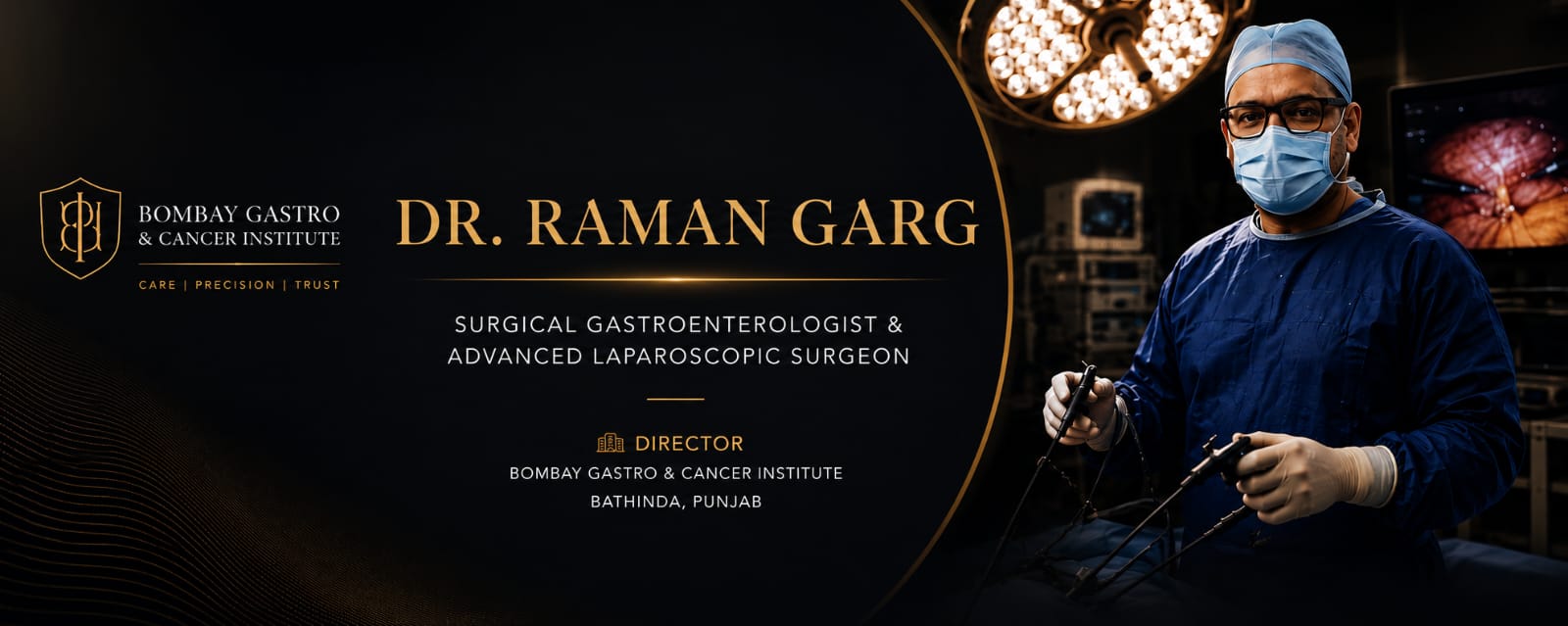
At Bombay Gastro & Cancer Institute (BGCI), Bathinda, Dr. Raman Garg — Senior Surgical Gastroenterologist with 20+ years of experience — has performed over 5,000 successful gallbladder stone removal surgeries using the safest, most modern laparoscopic techniques. Patients from Bathinda, Mansa, Muktsar, Faridkot, Sangrur, and across Punjab come to BGCI for definitive, permanent gallstone treatment.
"The only permanent cure for gallstones is removal of the gallbladder. Medicines can manage the pain temporarily, but they cannot dissolve stones permanently. Delaying surgery increases the risk of dangerous complications."
— Dr. Raman Garg, MBBS, MS, DNB (Surgical Gastroenterology), BGCI Bathinda
Symptoms of Gallstones – Are You Experiencing These?
Some gallstones are "silent" — causing no symptoms at all for years. Others cause sudden, intense pain. Here's what you should watch for:
Biliary Colic – The Classic Gallstone Attack
A biliary colic attack begins suddenly — often 30 minutes to 1 hour after a heavy or fatty meal. You feel a severe, cramping pain in the upper right abdomen that can radiate to the right shoulder or back. The pain peaks within 1 hour and usually lasts 1–5 hours. It often comes with nausea and vomiting. After the attack, you may feel sore in that area for several days.
Sudden severe pain in upper right abdomen (below ribcage)
Pain radiating to right shoulder blade or upper back
Pain triggered by fatty, fried, or oily foods
Nausea and vomiting during or after pain attacks
Feeling of fullness and bloating after eating
Belching, gas, and indigestion that won't go away
Yellowing of skin or eyes (jaundice — stone in bile duct)
Dark urine (tea-coloured) — sign of bile duct blockage
Pale or clay-coloured stools
Fever and chills (sign of infection — acute cholecystitis)
Persistent nausea without pain (silent gallstones)
Sudden severe pain with fever — MEDICAL EMERGENCY
Dangers of Ignoring Gallstones – Complications
Many people in Bathinda and Punjab delay gallstone surgery — hoping the pain will go away on its own, relying on home remedies, or postponing treatment due to fear of surgery. This is dangerous. Here's what untreated gallstones can lead to:
🔴
Acute Cholecystitis (Emergency)
If a stone blocks the outlet of the gallbladder, it becomes severely inflamed and infected. Symptoms: fever above 38°C, constant severe right-sided pain, vomiting. Requires emergency surgery within 24–72 hours.
🟠
Choledocholithiasis (Bile Duct Stone)
A small stone slips from the gallbladder into the common bile duct, causing jaundice, dark urine, pale stools, and severe pain. If left untreated, bile backs up into the liver and causes liver damage.
🔴
Acute Pancreatitis
A stone blocking the pancreatic duct opening can cause severe pancreatitis — life-threatening inflammation of the pancreas. Symptoms: very severe upper abdominal pain radiating to the back, vomiting, fever. Requires ICU care.
🟡
Gallbladder Perforation
Long-standing infection can cause the gallbladder to rupture (perforate), spilling infected bile into the abdomen, causing peritonitis — a life-threatening condition needing emergency surgery.
🟠
Cholangitis (Bile Duct Infection)
Infection spreading into the bile ducts causes Charcot's Triad: fever, jaundice, and right upper abdominal pain. Can progress to sepsis (blood poisoning) if untreated.
🟡
Gallbladder Cancer Risk
Chronic gallstone disease (especially large stones over 3cm and porcelain gallbladder) significantly increases the risk of gallbladder cancer — one of the most serious GI cancers.
If you have severe abdominal pain with fever and vomiting — call +91 82641-60001 immediately. This may be a gallbladder emergency.
Gallstone Treatment Options – Medicine vs Surgery
Many patients ask: "Can I dissolve gallstones with medicine or home remedies without surgery?" Let's be completely honest and transparent about this:
Option 1: Laparoscopic Surgery (RECOMMENDED – Permanent Cure)
Laparoscopic cholecystectomy (removal of gallbladder with stones) is the only permanent, proven cure for symptomatic gallstones. Once the gallbladder is removed, stones can NEVER form again. Surgery at BGCI takes 30–60 minutes, you go home the same day, and return to normal life in 1–2 weeks.
0% recurrence
Same-day discharge
Tiny scars
Gold standard worldwide
Option 2: Ursodeoxycholic Acid (UDCA) Tablets
These bile acid tablets can dissolve small cholesterol stones in people who cannot have surgery due to medical reasons. However: they work in only 30–40% of carefully selected patients, take 6–24 months to work, cause 70–80% recurrence within 5 years after stopping, and don't help with pigment stones or large stones. NOT a substitute for surgery for most patients.
Option 3: Home Remedies / "Pathri Galane ke Nuskhe"
Apple cider vinegar, olive oil flushes, lemon juice, and other home remedies do NOT dissolve or remove gallstones. They have zero scientific evidence. Some can trigger severe gallbladder attacks or dangerously worsen your condition. Please do not rely on these — see a qualified specialist at BGCI Bathinda instead.
Recovery After Gallstone Removal Surgery
Day of Surgery
Wake up after anaesthesia. Sip water, eat light khichdi or soup. Walk slowly around the ward. Go home with your family the same evening.
Day 1–3
Rest at home. Mild soreness at incision sites — managed with oral painkillers. Soft diet (dal, khichdi, curd, fruits). Short gentle walks indoors.
Day 4–7
Pain resolves significantly for most people. Stop pain tablets. Short walks outside. Light daily activities are fine. Avoid heavy lifting.
Week 2
Return to desk work or office. Light driving. Normal conversation, socialising, and household activities are all fine.
Week 3–4
Resume normal diet — introduce regular foods gradually. Light exercise (walking, yoga). Avoid heavy gym work and lifting for 4 weeks.
Month 2 onwards
Completely back to normal. No dietary restrictions for most people. Full activity resumption including gym, sports, heavy work.
Diet Tips After Gallstone Surgery
Start with liquids and semi-solid foods. Eat small meals 5–6 times a day (don't skip meals). Avoid fried, oily, spicy food for 6 weeks. Include more fruits, vegetables, whole grains, and low-fat dairy. Stay well hydrated (8–10 glasses of water per day). Mild loose stools in the first 2–4 weeks is normal and temporary — your body is adjusting.
What Our Patients Say
"Mujhe 2 saal se pitt ki pathri thi. Bahut dard hota tha khana khane ke baad. Dr. Raman Garg ne laparoscopic surgery kari. 4 chhoti se cuts aur surgery ho gayi. Usi din ghar aayi. Ab koi problem nahi. BGCI best hospital hai Bathinda mein."
Harpreet Kaur, Bathinda
★★★★★
"Meri wife ki gallbladder mein 15 pathriyaan thi. Hamne bahut jagah consult kiya. BGCI Bathinda mein Dr. Garg ne bahut patience se samjhaya aur surgery kari. 3 hafte mein poori tarah normal. Bahut shukriya."
Baldev Singh, Mansa
★★★★★
"Mujhe jaundice bhi ho gayi thi pathri ke wajah se. BGCI mein pahle ERCP karke bile duct saaf kiya phir gallbladder surgery ki. Doctor ne bilkul sahi guide kiya. Ab 6 mahine ho gaye, koi takleef nahi."
Jaswant Rai, Muktsar
★★★★★