What is a Hernia? Understanding the Condition
A hernia occurs when an internal organ or fatty tissue squeezes through a weak spot or tear in the surrounding muscle or connective tissue wall. Imagine a small balloon of tissue pushing through a hole in a rubber sheet — that's essentially what happens with a hernia. It creates a visible bulge that may be painful, especially when you cough, bend, or lift something heavy.
Hernias are extremely common in India, particularly in Punjab. They don't go away on their own — in fact, most hernias gradually enlarge and become more painful over time. Without surgical treatment, they can lead to dangerous complications like bowel strangulation, which is a medical emergency.
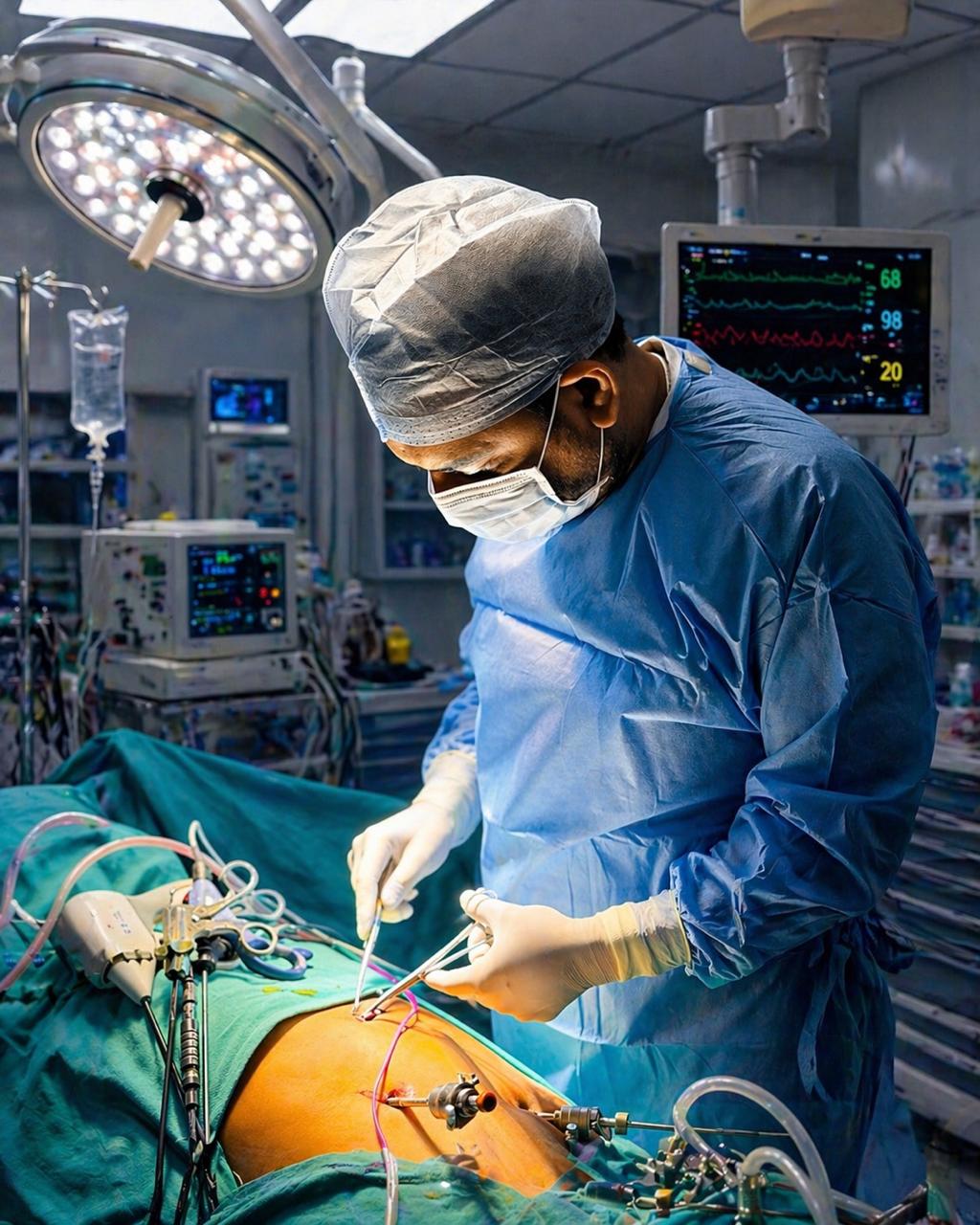
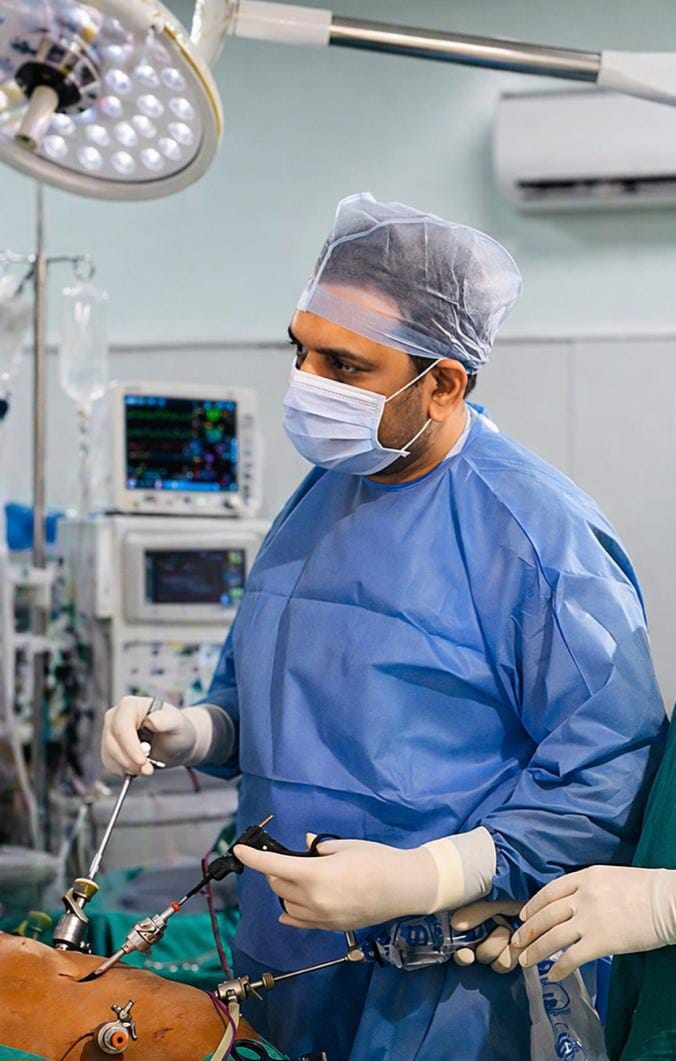
At Bombay Gastro & Cancer Institute (BGCI), Bathinda, Dr. Raman Garg — the first Surgical Gastroenterologist of the Malwa region — has successfully performed over 10,000 hernia surgeries using state-of-the-art laparoscopic techniques. If you have a hernia in Bathinda or nearby areas (Mansa, Muktsar, Faridkot, Sangrur), BGCI is your best choice for expert, affordable care.
"A hernia will never heal on its own. The longer you wait, the more complicated — and risky — the surgery becomes. The best time to get it treated is now, while it's still straightforward."
— Dr. Raman Garg, Senior Surgical Gastroenterologist, BGCI Bathinda
Types of Hernia Treated in Bathinda
Dr. Raman Garg at BGCI Bathinda treats all types of hernias — simple to complex, single to bilateral, first-time to recurrent. Here is a detailed overview of each type:
Inguinal Hernia (Groin Hernia)
The most common type, accounting for 75% of all hernias. Tissue pushes through a weak point in the lower abdominal wall into the groin area. Much more common in men due to the natural opening left by the spermatic cord. You'll notice a bulge in the groin that appears when standing or straining. Treatment: Laparoscopic TAPP or TEP mesh repair — same-day discharge.
Umbilical Hernia (Navel Hernia)
Occurs when fatty tissue or part of the bowel pushes through the abdominal wall near the belly button (navel). Common in newborns (often heals on its own), but adult umbilical hernias always need surgical repair. Caused by obesity, pregnancy, or repeated straining. Treatment: Laparoscopic repair with mesh — excellent cosmetic results.
Incisional Hernia
Develops at the site of a previous surgical incision, where the abdominal wall has weakened during healing. Very common after abdominal operations like appendix, C-section, or weight loss surgery. Can occur months or years after the original surgery. Treatment: Laparoscopic IPOM mesh repair.
Hiatal Hernia
The upper part of the stomach pushes up through the diaphragm into the chest cavity. Causes acid reflux (heartburn), regurgitation, difficulty swallowing, and chest pain. Very often misdiagnosed as simple acidity. Treatment: Laparoscopic hiatal hernia repair with or without fundoplication.
Femoral Hernia
More common in women, especially after pregnancy. Tissue pushes through a weak area in the inner thigh just below the groin. Has a higher risk of strangulation than inguinal hernias, so prompt surgery is essential. Treatment: Laparoscopic repair.
Ventral Hernia
A general term for a hernia that occurs anywhere on the front of the abdominal wall. Can be caused by weakness at the midline (epigastric hernia) or previous surgeries. Treatment: Laparoscopic mesh-based repair.
Recurrent Hernia
A hernia that comes back after a previous repair. More challenging to treat — requires an experienced surgeon. Dr. Raman Garg specialises in complex recurrent hernia repairs using advanced laparoscopic techniques. Treatment: Specialist laparoscopic re-repair.
Strangulated / Obstructed Hernia
A surgical emergency. If the blood supply to the herniated tissue is cut off (strangulation), the tissue begins to die. Signs: sudden severe pain, vomiting, hernia cannot be pushed back. Requires emergency surgery immediately. Emergency line: +91 82641-60001.
Hernia Symptoms – When to See a Doctor in Bathinda
Hernia symptoms vary depending on type and severity. Some hernias are painless at first — just a soft bulge — but they gradually worsen. Watch for these warning signs:
Visible bulge or lump in the groin, navel, or abdominal area
Bulge that becomes larger when you stand, cough, or strain
Dull ache or sharp pain at the bulge site
Pain that gets worse during physical activity, lifting, or bending
Feeling of heaviness or pressure in the groin or abdomen
Burning, tingling or aching sensation at the hernia site
Discomfort when sitting or standing for long periods
Nausea and vomiting (in obstructed hernia)
Inability to push the bulge back (sign of incarcerated hernia)
Sudden severe pain — EMERGENCY (strangulated hernia)
Swelling and redness around the bulge
Constipation or difficulty passing stools
Emergency: If you have a hernia with sudden severe pain, vomiting, and cannot push the bulge back — this is a surgical emergency. Call +91 82641-60001 immediately.
Hernia Surgery at BGCI Bathinda – How It's Done
Dr. Raman Garg uses the most advanced laparoscopic techniques for hernia repair. The two main approaches used at BGCI Bathinda are:
TAPP – Transabdominal Preperitoneal Repair
The surgeon enters the abdominal cavity through 3 small incisions (5–10mm). The peritoneum (inner lining) is opened, and a large surgical mesh is placed between the abdominal wall and peritoneum. The mesh is then covered by closing the peritoneum. Excellent for bilateral hernias (both sides), recurrent hernias, and large inguinal hernias.
Bilateral hernia
Recurrent hernia
Large hernia sac
TEP – Totally Extraperitoneal Repair
The surgeon works entirely outside the abdominal cavity, between the peritoneum and abdominal wall. No entry into the abdomen means lower risk to internal organs. Mesh is placed in the preperitoneal space. Preferred when intra-abdominal risks exist (previous surgeries, adhesions).
Lowest organ risk
Previous abdominal surgery
Unilateral hernia
Surgical Mesh: A special synthetic mesh (polypropylene) is used to reinforce the weakened area permanently. This is what makes the repair strong and prevents the hernia from coming back. The mesh is biocompatible and stays inside the body permanently. Modern meshes are lightweight, flexible, and the body tolerates them extremely well.
Step-by-Step: What Happens on Surgery Day
1
Arrival & Pre-op
Arrive at BGCI Bathinda. Nursing team checks your vitals, anaesthesia team reviews your fitness. Pre-op medicines given.
2
General Anaesthesia
You're gently put to sleep. The surgical team prepares the operative field. You feel nothing throughout.
3
Small Incisions Made
3 cuts of 5–10mm are made — one at the navel, two others nearby. A trocar (tube) is inserted.
4
CO₂ Inflation
Medical-grade CO₂ gas gently inflates the abdominal space, creating room for the surgeon to work safely.
5
HD Camera View
A high-definition laparoscope (camera) shows the entire operative field on a screen — better than the naked eye could ever see.
6
Hernia Repair & Mesh
The hernia sac is identified, reduced (pushed back), and a surgical mesh is placed to cover and reinforce the weak area permanently.
7
Closing Up
Instruments removed, CO₂ released, incisions closed with dissolvable sutures and skin adhesive. Done in 30–60 minutes.
8
Recovery & Discharge
You wake up comfortably. Start fluids, walk a little. Go home in 4–6 hours with simple pain tablets.
What Our Hernia Patients Say
"Mujhe inguinal hernia tha 2 saal se. Dr. Raman Garg ne laparoscopic surgery kari aur main usi din ghar aa gaya. Bilkul dard nahi tha. 5 din mein office bhi gaya. BGCI best hai Bathinda mein."
Gurpreet Singh, Bathinda
★★★★★
"Meri umbilical hernia ki surgery BGCI Bathinda mein hui. Doctor ne Punjabi mein sab samjhaya. Operation chhota sa tha, nishan bhi nahi. 3 hafte mein poori tarah theek ho gayi."
Kamlesh Devi, Muktsar
★★★★★
"Dr. Raman Garg bahut experience waale doctor hain. Meri recurrent hernia thi — doosri baar — par unhone badi asaani se laparoscopic surgery ki. Ab koi problem nahi."
Sukhwinder Pal, Mansa
★★★★★