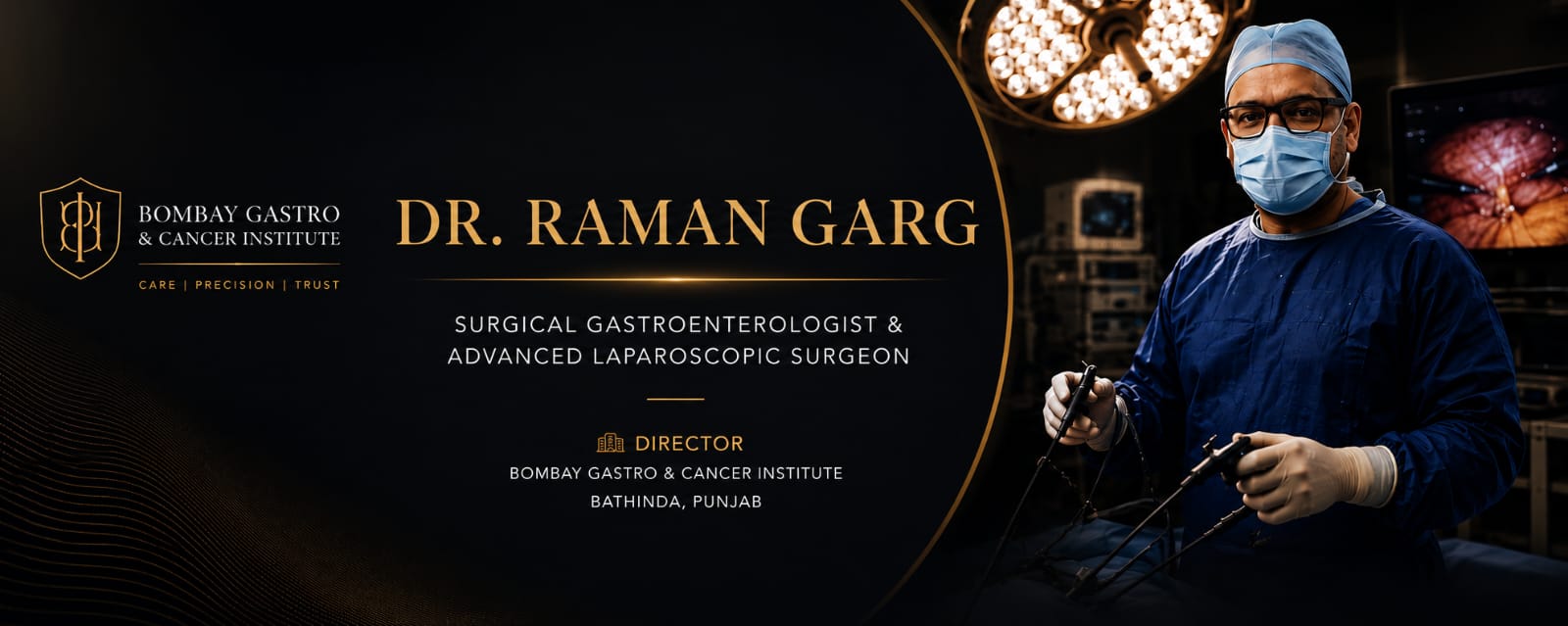
Gallbladder Surgery in Bathinda Advanced Laparoscopic Cholecystectomy
Suffering from gallstone pain? Get permanent relief with minimally invasive laparoscopic gallbladder surgery performed by Dr. Raman Garg — Bathinda's most experienced Surgical Gastroenterologist. Same-day discharge, tiny scars, fast recovery.
Gallbladder surgery — medically known as cholecystectomy — is a procedure to remove the gallbladder, a small pear-shaped organ located just beneath your liver on the right side of your abdomen. The gallbladder stores bile, a digestive fluid produced by the liver. When gallstones or inflammation cause repeated pain, infection, or blockage, removing the gallbladder becomes the most effective and permanent solution.
At Bombay Gastro & Cancer Institute (BGCI), Bathinda, Dr. Raman Garg performs laparoscopic cholecystectomy — a keyhole (minimally invasive) surgery that uses just 3–4 tiny cuts instead of one large incision. This means less pain, minimal blood loss, faster recovery, and near-invisible scars. You go home the same day or the next morning.
If you or your family member is experiencing upper abdominal pain after eating fatty foods, nausea, vomiting, bloating, or has been told they have gallstones on ultrasound — this page is for you. Read on to understand everything about gallbladder surgery in Bathinda.
"The gallbladder is not an essential organ. Once removed, your liver continues to produce bile that flows directly to your intestine — and most people live perfectly healthy, normal lives without it."
— Dr. Raman Garg, Surgical Gastroenterologist, Bathinda
Why Would You Need Gallbladder Surgery?
Gallbladder surgery is recommended when the gallbladder causes ongoing health problems. The most common reasons include:
Gallstones (Cholelithiasis)
Hard deposits of cholesterol or bile salts that form inside the gallbladder, causing severe pain especially after eating fatty meals.
Acute Cholecystitis
Sudden, severe inflammation of the gallbladder — usually from a gallstone blocking the outlet, causing fever and intense right-sided pain.
Biliary Colic
Repeated episodes of sharp pain in the upper right abdomen when gallstones temporarily block the bile duct.
Gallbladder Polyps
Growths on the gallbladder wall — if larger than 1 cm, removal is recommended to prevent cancer risk.
Choledocholithiasis
Gallstones that have slipped into the bile duct, causing jaundice, fever, and risk of pancreatitis.
Gallbladder Cancer (Early)
Early-stage gallbladder cancer where complete removal of the gallbladder is the first line of treatment.
Chronic Cholecystitis
Long-term, recurring inflammation of the gallbladder that leads to scarring, poor function, and persistent discomfort.
Acalculous Cholecystitis
Gallbladder inflammation without stones — usually in critically ill patients or after major surgery.
Warning: If you have sudden severe pain in the upper right abdomen with fever, yellowing of skin/eyes, or vomiting — seek emergency care immediately. These may be signs of gallbladder infection or bile duct blockage.
Symptoms You Should Not Ignore
Gallbladder problems often start mild and get worse over time. Here are the warning signs that mean you should see a specialist in Bathinda immediately:
Sharp or cramping pain in the upper right side of the abdomen
Pain that radiates to the right shoulder or back
Pain that worsens after eating fried, oily, or fatty foods
Nausea and vomiting after meals
Feeling of fullness or bloating in the stomach
Indigestion and heartburn that doesn't go away
Yellowing of the skin or whites of the eyes (jaundice)
Dark-coloured urine (like tea or cola)
Pale or chalky-coloured stools
Fever and chills (sign of infection)
Loss of appetite and unexplained weight loss
Persistent gas, belching, or discomfort after eating
How is Gallbladder Disease Diagnosed?
Before recommending surgery, Dr. Raman Garg conducts a thorough evaluation to confirm the diagnosis and understand the exact condition of your gallbladder. This typically includes:
Abdominal Ultrasound
The first and most important test. It detects gallstones, gallbladder wall thickening, and fluid around the gallbladder. Over 95% accurate for detecting stones.
Blood Tests (LFT, CBC)
Liver Function Tests detect abnormal enzyme levels caused by bile duct blockage or infection. CBC helps identify signs of infection or inflammation.
MRCP (MRI Cholangiography)
A non-invasive MRI scan used to see the bile ducts clearly — especially useful to detect stones in the bile duct (choledocholithiasis).
CT Scan Abdomen
Used in complex cases, acute cholecystitis, or suspected complications to get a detailed 3D view of the gallbladder and surrounding organs.
HIDA Scan
A nuclear medicine scan to evaluate gallbladder function — used when symptoms exist but ultrasound appears normal.
ERCP
If stones are found in the bile duct, this endoscopic procedure can remove them before or during gallbladder surgery.
The Gallbladder Surgery Procedure – Step by Step
Dr. Raman Garg performs laparoscopic cholecystectomy — the gold standard for gallbladder removal worldwide. Here is exactly how the procedure works at BGCI, Bathinda:
1
Pre-Surgery Preparation (Day Before)
You'll be asked to fast from midnight before surgery. Blood tests, ECG, chest X-ray and anaesthesia fitness are completed. The surgical team explains everything and answers your questions.
2
Anaesthesia
You'll be given general anaesthesia — you'll be completely asleep and feel nothing during the surgery. The procedure takes 30–60 minutes.
3
Creating Access (4 Small Incisions)
The surgeon makes 3–4 tiny cuts (each 5–10mm) in your abdomen. A special gas (CO₂) is gently inflated to create space to work inside.
4
Inserting the Laparoscope
A slim camera (laparoscope) is inserted through one of the cuts. It transmits a magnified, HD video of your internal organs to a monitor — giving the surgeon a clear, precise view.
5
Identifying & Clipping Structures
The cystic duct and cystic artery — the connections to the gallbladder — are carefully identified, clipped with titanium clips, and divided. This prevents any bile leak.
6
Removing the Gallbladder
The gallbladder is gently detached from the liver and removed through one of the small incisions, usually inside a retrieval bag.
7
Closing & Recovery
The tiny incisions are closed with dissolvable sutures and small adhesive strips. You go to the recovery room and are usually ready to go home in 4–6 hours.
Laparoscopic vs. Open Surgery – Which is Better?
Feature
Laparoscopic (Keyhole)
Open Surgery
Incision size
3–4 cuts of 5–10mm
One large 10–15cm cut
Pain after surgery
Minimal
Significant
Hospital stay
Same day or 1 night
3–5 days
Return to work
3–5 days
4–6 weeks
Scarring
Tiny, nearly invisible
Large, visible scar
Risk of infection
Very low
Higher risk
Recovery time
2–3 weeks
6–8 weeks
Complication risk
Lower
Higher
Note: In over 95% of cases, Dr. Raman Garg performs laparoscopic cholecystectomy. Open surgery is only used in rare, complex situations like severe infection or unexpected complications.
Recovery After Gallbladder Surgery
Recovery from laparoscopic gallbladder surgery at BGCI Bathinda is remarkably quick and smooth. Here's what you can expect:
Same Day
Wake up comfortably after surgery. Start sipping water and clear fluids. Walk around the ward with nursing support. Go home in 4–6 hours.
Most patients feel significantly better. No need for pain medication for most people. Walk daily for 15–20 minutes. Short car rides are fine.
Week 2
Return to desk job or light work. Energy levels normalise. Bathing and light daily activities are fully possible.
Week 3–4
Resume normal diet gradually. Light exercise like walking, yoga can begin. Avoid heavy lifting (>5kg) for 4 weeks.
Month 2 onwards
Complete normalcy. No dietary restrictions for most people. Resume sports, gym, and all activities normally.
Diet Tips After Surgery:
Start with light, low-fat foods. Avoid fried, spicy, or oily foods for 4–6 weeks. Eat small, frequent meals (5–6 times a day). Stay well hydrated. Most people return to a normal diet within 6–8 weeks.
Why Choose Laparoscopic Gallbladder Surgery at BGCI Bathinda?
Painless Procedure
General anaesthesia ensures you feel nothing during surgery. Post-op pain is minimal and managed with simple tablets.
Go Home Same Day
Day-care surgery — most patients leave the hospital within 6–8 hours of the procedure.
Near-Invisible Scars
3–4 tiny cuts of just 5–10mm each. Scars fade completely within weeks.
Back to Work in Days
Most people return to desk jobs in 3–5 days. Physical workers return in 2–3 weeks.
Lowest Complication Rate
Laparoscopic surgery significantly reduces the risk of infection, hernia at incision site, and post-op complications.
Affordable & Insured
BGCI accepts Ayushman Bharat, CGHS, and most insurance plans. Transparent billing, no hidden charges.
Life After Gallbladder Removal – What to Expect
One of the most common concerns patients have is: "Will I be able to eat normally after gallbladder removal?" The honest answer is — yes, most people do. Here's what actually happens:
Your liver will continue producing bile as before. Without the gallbladder, bile flows directly and continuously from the liver into the small intestine, instead of being stored and released in bursts. Your body adjusts to this in 4–8 weeks.
Some people experience mild loose stools or bloating in the first few weeks — this is temporary and improves as the body adapts. Following a low-fat diet initially helps significantly.
The vast majority of Dr. Raman Garg's patients report that they feel tremendously better after surgery — free from the recurring pain, nausea, and fear that gallstones had caused for months or years.
Frequently Asked Questions
The exact cost depends on the specific condition, type of surgery, and insurance coverage. At BGCI Bathinda, we offer transparent pricing and work with Ayushman Bharat, CGHS, and other insurance panels. Call us at +91 82641-60001 for a detailed cost estimate.
Yes, laparoscopic cholecystectomy is one of the safest and most commonly performed surgeries in the world. Dr. Raman Garg has performed over 10,000 successful procedures with an excellent safety record.
Most patients need 3–7 days of home rest after laparoscopic surgery. You can return to desk work in 3–5 days and resume full activity in 2–3 weeks.
No. Once the gallbladder is completely removed, gallstones cannot form again. This is a permanent solution.
No. Most people return to a normal, unrestricted diet within 6–8 weeks after surgery. Initially, a low-fat diet is recommended to help your body adjust.
Yes. If you develop acute cholecystitis (severe infection), perforation, or bile duct obstruction, emergency surgery may be needed. Don't delay if you have severe pain with fever.
Delaying surgery when it's recommended increases the risk of complications like severe infection, perforation, bile duct blockage, and pancreatitis — all of which are much harder to treat.
You can call +91 82641-60001, WhatsApp us, or fill the appointment form on this website. OPD timings are Monday to Saturday, 10 AM to 3 PM at BGCI, Power House Road, Bathinda.
Book a Free Consultation
Dr. Raman Garg – Gallbladder Specialist, Bathinda
Dr. Raman GargMBBS, MS, DNB (Surg. Gastro) 20+ Years · 10,000+ Surgeries